The Stump and the Shoot: On Grief, Identity, and Rediscovery
“Not until we are lost do we begin to find ourselves.” — Henry David Thoreau, Walden
I recently watched three films back to back — Eleanor the Great, Eternity, and I Want to Talk. They have nothing in common on the surface: a grieving widow reinventing herself in New York, a woman choosing between two loves in the afterlife, a dying man quietly repairing things with his daughter. But sitting with all three in the span of a few days, something kept surfacing. Each film is really about who you are once the scaffolding falls away. Once the roles you built yourself around — caretaker, provider, partner, parent — no longer look the way they used to.
That landed differently for me than it might have a few years ago.
When Everything Falls at Once, You Just Keep Moving
Within a few years, I was laid off twice. I lost my uncle, my grandfather, and my father. I went through a divorce. Most of the time I was carrying these things, I wasn’t processing them — I was managing them. There’s a difference.
My dad was disabled for years before he died. His friends gradually drifted away, as they do. My grandfather stepped more into our lives because of it. I spent a lot of real time with both of them. Unhurried time. I don’t carry regret about that. But when they were gone, there were kids to feed, jobs to find, and a life that kept demanding forward motion. Grief became something you did in the margins. The machine kept running.
Working in tech during a period of rampant layoffs doesn’t help you slow down. The professional identity — hard-working, dependable, someone who shows up regardless of what’s happening at home — is a load-bearing wall. You lean on it. You let it hold things up that maybe need to fall.
Being in management during this period added a particular kind of pressure. The expectation on leaders doesn’t soften when your personal life is falling apart — it quietly intensifies. You’re still making decisions that affect other people’s livelihoods. You’re still expected to project steadiness and make the right call. There’s a phrase I heard early in my career that kept coming back: the business always wins. Meaning the work demands what it demands regardless of what’s happening at home. I’m proud of how I navigated it. But I want to be honest that it was a genuine struggle — some days consciously, others in ways I didn’t fully recognize until much later.
What I came to value enormously, on the other side of it, were the people who paused and actually asked how I was doing. Not as a formality. As a real question. People carry enormous weight silently in professional environments, and the cost of not acknowledging that rarely shows up in any metric. People struggle silently at work all the time. Asking how someone is doing, and meaning it, is not a small thing.
The Giving Tree Isn’t Really About the Tree
Before the losses, I had been carrying something else for a long time. My ex-wife struggled with severe depression, anxiety, and postpartum illness. There were hospitalizations. There were years where stability was the only goal, and I was the one holding the household together for the kids while she found her way through it. What gets lost in those situations — and I think it gets lost easily — is that caretakers are struggling too. The focus, rightfully, goes to the person in crisis. But the person holding everything together around them is carrying something real, and it often goes unacknowledged. You don’t get asked how you’re doing. You’re just expected to keep the lights on, and you do, because what’s the alternative.
I’m not recounting this for sympathy — I’m recounting it because it shaped everything about who I thought I was. Hard work. Resilience. Keep moving.
And then stability arrived, and with it a different person than the one I’d been holding space for. The dynamic that had been building for years — partner, then caretaker, then someone trying to restore a relationship with a person I no longer recognized — finally collapsed under its own weight.
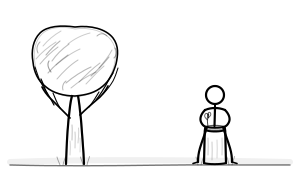
I kept thinking about Shel Silverstein’s The Giving Tree. Most people read it as a story about unconditional love. I think there’s another reading: a story about what happens when one party’s identity becomes entirely defined by what the other needs from them. The tree gives away its apples, its branches, its trunk. By the end, it cannot even be a tree. It is a stump. And the boy comes back one more time.
I’d spent years being the tree. I don’t say that with bitterness — I made choices, and a lot of them were right ones. The kids had food on the table. We had good moments. What I wasn’t prepared for was how little of it came back.
The harder lesson — the one that took longer to arrive — is that not everyone deserves that level of dedication. That sounds straightforward. It didn’t feel straightforward. When you give that much of yourself to someone and what comes back is resentment, what you’re left with isn’t just grief or disappointment. It’s a particular kind of exhaustion: the slow recognition that the value you placed on something wasn’t placed back on you. That feeling doesn’t have a clean name, but it sits somewhere between loss and disillusionment. The dedication itself wasn’t the mistake. Giving it without recognizing my own needs in return was.
Your Greatest Strength Can Be Your Biggest Weakness
Here is the uncomfortable truth I’ve had to sit with: the resilience that helped me survive those years also made it easier to avoid the harder work of actually processing any of it. If you’re wired to keep moving, to be the responsible one, to not let things fall apart — that wiring doesn’t come with an off switch. Endurance is useful. It’s also a way of not stopping long enough to feel the weight of what you’re carrying.
In I Want to Talk, there’s a character given 100 days to live who keeps defying the timeline — not through denial but through a kind of determined, quiet engagement with the people who matter. He doesn’t resolve everything. He doesn’t tie it up. But he stops treating vulnerability as a weakness. That shift is small in the film and enormous in practice.
I don’t think I fully understood that distinction until recently.
The Particular Loneliness of Starting Over
What Eleanor the Great gets right — and what I wasn’t fully prepared for — is how lonely the in-between is.
Eleanor loses her closest friend, the person she shared the rhythm of daily life with for years. She moves to New York to be near her daughter, who loves her but has her own full life. Eleanor finds herself in a grief support group, telling her dead friend’s story as her own — not out of deception for its own sake, but because the alternative is sitting alone with everything. She moved toward people and ended up borrowing someone else’s story just to find a way in.
I’m a people person. I’ve always been wired for connection. What I underestimated was how much of my daily life was held up by the specific people in it. When you get laid off, you don’t just lose a job. You lose the colleagues you saw every day, the team you built something with, the low-grade daily belonging of showing up somewhere that knows your name. When a marriage ends, you lose the structure of a life that was built for two. When your father dies, you lose the particular companionship that only exists between a parent and a child.
None of those losses feel the same. But the loneliness they leave has the same shape. You can be surrounded by people and still feel the specific absence of the ones who are gone. Building new connection from scratch — in your forties, after all of that — turns out to be harder than anyone warns you about.
The Shoot Coming Up From the Stump
I have a good job now. I’m still a good dad — that was never really in question, but it’s worth saying. I have an incredible girlfriend of two years. The resentment I carried for so long is mostly gone, and its absence is genuinely surprising — I didn’t know how much weight I’d been assigning to it until it lifted.
But I’d be lying if I said I’ve fully processed the last several years. I don’t think you do, fully. The grief for my dad and my grandfather is still present in quiet ways. The identity I built around being the provider, the caretaker, the one who keeps things running — that version of me isn’t entirely gone, but it’s not the whole story anymore either. I’m figuring out what the rest of it looks like.
I Want to Talk circles something I’ve felt directly. Each surgery Arjun faces doesn’t just test his resilience — it sharpens his focus on what he’d been letting slip. Not through dramatic revelation, but through the slow, accumulating weight of almost losing everything making it undeniable.
The lived experience does that. Carrying all of it — the grief, the caretaking, the professional pressure, the divorce — meant there were people in my life who deserved more of me than they always got. The kids. My family. My girlfriend, who has shown me what it actually looks like when someone cherishes you. I wasn’t always my best to them during those years, and I know it. What reflection gave me — eventually — wasn’t guilt so much as clarity. A reaffirmation of what matters, and the motivation to keep choosing it.
Eternity ends with the realization that the accumulated weight of ordinary, shared days matters more than any single defining moment. I think that’s right. The person I’m becoming isn’t being built through some dramatic arc of self-discovery. It’s being built through showing up, again, in a life that has a lot less accumulated resentment and a lot more room in it.
I still don’t know exactly what to make of the last several years. But I’m a better version of myself for having gone through them, and I know that’s true even when I can’t fully explain why.
What I’m still working out is whether “rediscovering your identity” is the right frame at all — or whether you’re just finally getting honest about who you’ve been the whole time, once you stop needing to hold everything up by yourself.